|
Systems
ATCA
and AMC
PMC
Modules
Processing
Blades
Protocol
Bundles
Request Documentation
|
|
Embedded
Computing
Kosai™PM
Intel® Pentium-M® based
AdvancedMC Module |
 |
- Intel Pentium-M® running at up to 1.8GHz
- Full-height and Half-height PICMG AMC formfactor
- Up to 2GB DDR or DDR2 DRAM with ECC
- 1GB NAND Flash
- Dual GBit Ethernet connectivity to AMC connecto
- PCI Express connectivity to baseboard
- Full hotswap support
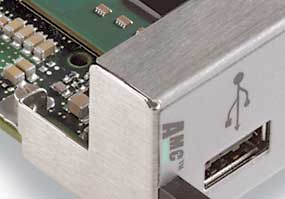
- USB and Console serial ports via front panel
- Intelligent peripheral management functionality
- Carrier Grade Linux support
- RoHS/WEEE compliant configuration available
- Quality assured by over 35 years of design experience and
a TL-9000 and ISO 9001:2000 certified quality management system.
(FM 26789)

Advanced Mezzanine Card (AMC) is a collaboration of major telecom
OEMs and suppliers to create an optimal expansion platform for
AdvancedTCA or proprietary baseboards that addresses major bandwidth,
availability, field upgradeability, cost, scalability, management
and interoperability issues.
KosaiPM is an AMC module based on the Intel Pentium-M processor,
providing a complete processor subsystem. It is designed to allow
communication equipment manufacturers to add modular and upgradeable
compute functionality to their AdvancedTCA or proprietary baseboards
and provide the localized horsepower necessary for applications
such as protocol processing, packet processing, data management
and I/O management.
To support high-speed packet data transfers on and off the card,
KosaiPM features both PCI Express and dual GBit Ethernet interfaces
to the baseboard. With everincreasing application and data transfer
requirements, this combination of more traditional GBit Ethernet
interfaces and the emerging PCI Express interface allows developers
to easily migrate existing applications to PCI Express.
KosaiPM is hot-swappable, which allows modules to be replaced
by operators or service organizations in the field without bringing
down an entire AdvancedTCA blade or system. This reduces spares
costs and mean-time-to-repair (MTTR), lowering both CAPEX and
OPEX. KosaiPM also provides an IPMI-based system management interface,
which enables operators to pinpoint and fix problems at the module
level, also lowering MTTR and OPEX.
Intel Pentium-M running at up to 1.8GHz
- 64-bit data bus
- 32-bit address bus
- 2MB L2 Cache with ECC
- 400MHz processor system bus
Intel North Bridge E7520
- 400Mhz processor system bus
- Dual Data Rate SDRAM controller
6300ESB South Bridge
- Serial and USB interfaces
- 2-Stage watchdog timer
- Serial ATA to AMC Connector
SDRAM
- 256, 512 MByte, 1 or 2 GByte SDRAM with Error Checking and
Correction (ECC)
- DDR266 or DDR2 400
- SO-DIMM
Boot Flash
- Firmware Hub (Intel 82802AC Compatible)
Flash
Ethernet
- Dual GBit Ethernet SERDES via AMC Connector
PCI Express
- Single x8 or Dual x4 via AMC connector
- PCI Express Rev1.0a Compatible
Serial I/O
- One console serial port
- EIA-232 signal levels
- Mini-USB connectors with front bezel access
- One USB port
- Standard USB connector
- USB 2.0
- Front panel access
JTAG
- Available via plug over module for development
- JTAG/ITP debug interface
- IEEE 1149.1 compatible
- Access to internal processor scan chains for debug
- Connection to processor core for emulator support
- JTAG interface for on-card PLDs
IPMB
- System Management Bus (SMB) designed to support AMC.0
- Driven by Pigeon Point Managment device
- Remote shutdown
- Remote reset
- Payload Voltage Monitor
- Temp monitor
- FRU data structure
- Power/fault front panel status LEDs
- Hot Swap front panel LED
- 1 User determined front panel LED
- Recessed front panel definable reset switch
- Designed to work in PICMG AMC.0/.1/.3 environments
- Single-Wide/Full-Height
- Single-Wide/Half-Height
- PCB Dimensions: 181.50mm x 73.5mm
- Power requirements: 40W typical
- Operating range: 0° to 55° C, 5-95% relative humidity
(non-condensing) to meet or exceed NEBS Telcordia GR-63 specification
- UL/CSA/EN60950
- NEBS: Applicable sections of Telcordia GR-63 and GR-1089
- FCC Part 15, (US)/ ICES 003, (Canada)
- EN 55022
- EN 55024
- EN 300 386
- Pentium Bios with power-on self test
- Reference kernel port for GPL Linux
- Carrier Grade Linux Support

11/07 |